


Close


Close
At Blue Gum Family Day Care, every child is celebrated for who they are and supported to reach their full potential.
For educator Ashton, inclusion isn’t an added feature of her program, it’s the foundation on which everything is built. Her neurodiversity-affirming approach ensures that children with diverse developmental needs feel welcome, safe and able to thrive in a nurturing family day care environment.
Located in Logan, Queensland, Ashton opened Blue Gum in January 2024 after leaving her role as an educational leader in a bilingual long day care. Four children followed her into family day care, seeking the continuity, stability and deep connection they had already built with her. Since then, her family day care has grown organically as more families hear about her inclusive approach.
As a mother of five, Ashton draws on both her professional expertise and lived experience. She identifies as neurodiverse and has raised neurodivergent children of her own. This insight shapes the way she designs her environment, communicates with families and supports each child’s emotional, sensory and cultural needs. Her Māori heritage is also an important part of her practice and is incorporated into daily activities, creating a sense of identity and belonging for many of the Pacific Islander and Māori families she works with.
“I think I’ve helped families feel seen and understood, especially families raising neurodivergent or culturally diverse children who may have struggled to find the right fit elsewhere. I’ve always been a nurturer and starting a small family day care for neurodivergent and culturally diverse children is something I was drawn to because I live in both worlds,” she said.
Supported by Busy Butterflies Education and Care Service, Ashton offers before and after school care as well as vacation care for school aged children. When many of her children transitioned into primary school this year, she adjusted her hours to continue supporting their routines and emotional needs. Stability, predictability and secure relationships remain at the heart of her work.
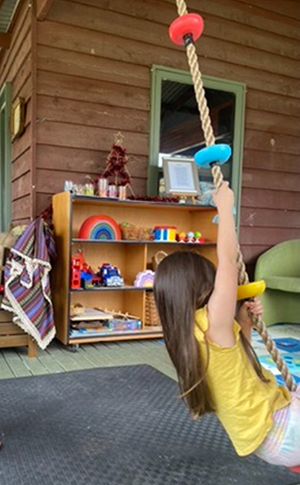
The environment at Blue Gum is intentionally different to a traditional classroom. Children can access both indoor and outdoor options for play, giving them autonomy to regulate their sensory needs and to choose the type of play that feels right for them. A large balcony deck ensures outdoor play is always available, even in wet weather. Ashton has also created variations of equipment to suit different sensory preferences, such as offering two sand pits – one with dry sand and one with wet sand.
To ensure the space works for the whole group, the lighting is kept dim to create a calm ambience, ‘cosy nooks’ are available throughout and a designated quiet zone offers children a place to decompress. Ashton keeps multiple copies of popular resources so that every child can access them. This incorporates small-world play creating opportunities for the children to explore emotions and make sense of their world using dolls and figurines.
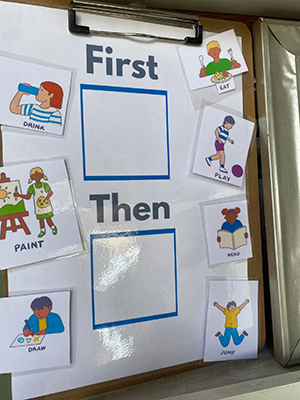
Visual aids and communication supports are used consistently throughout her environment. Everything, from activities to meal options, have picture cues to help children express themselves, anticipate routines and make decisions.
Ashton approaches programming from the perspective that all children can participate, the environment or the activity just needs to work for them.
“I always assume the children can do everything” she explains. “I never start a thought with ‘they can’t’, I always assume capacity.”
Using a strengths-based approach, she focuses on each child’s strengths and interests and then considers how they can be extended in natural and meaningful ways. By adapting activities, such as offering multiple ways to paint (on a wall, table or floor), ensures every child can engage at their own pace and comfort level.
The rhythm of the day also influences Ashton’s programming. Mornings are intentionally kept low stimulus, supported by lots of visual aids, familiar breakfast choices and ‘first-then’ boards.
Each day begins with a karakia (a prayer or blessing) and an Acknowledgment of Country, with all children taking part. Ashton acknowledges how powerful it can be to see all children, neurodivergent or not, benefit from embedding these rituals daily.
Ashton explains “everything is predictable and everything is discussed with parents the week prior, so there are no surprises. That really sets the children up for a successful morning.”
After the demands of the school day, the group usually unwinds with a sensory activity, often involving water. This helps children decompress from the structure and intensity of the school day and provides a calming transition into the afternoon routine.
While inclusion is central to Ashton’s philosophy, so too is ensuring her practice meets the highest standards of safety and compliance. She carefully considers equipment and activities from both a learning and safety perspective, ensuring that thoughtful planning supports rich, meaningful experiences that are child led, rather than limiting them. Ashton also ensures that she’s communicating with families, reflecting regularly with her coordinator on compliance, and embracing problem solving, thinking outside the box and trial and error.
“I just try to put myself in the children's shoes as well and really think over the safety aspect. I always want things to happen if a child wants to do something, I will try and make sure that it happens” she said. “I have a risk assessment for absolutely everything.”
Linking with allied health professionals, government programs and local facilities has strengthened the holistic approach at Blue Gum. Speech pathologists and dietitians have visited her service, and Ashton takes advantage of local facilities such as the toy library and community library, even bringing story time into her home so that all children can participate.
Working closely with families is part of her success. She reflects on how isolating it can feel for families raising neurodivergent children and is determined to provide support that helps ease that experience wherever she can. Families often ask her for recommendations on schooling options, allied health services or community supports, and Ashton openly shares her knowledge and lived experience. Through regular communication, active listening and genuine partnership, she works with families to create consistent, responsive approaches that support each child’s wellbeing and development.
Beyond her own service, Ashton is also sharing her knowledge about inclusive practice across the sector. She has conducted workshops at the long day care center where she previously worked and recently presented Celebrating Play and Finding Joy in Neurodiversity in the Family Day Care Environment: Neurodiversity Affirming Practice at the FDCA 2025 National Conference. She also presented Strengthening Mana in the Early Years: A Pathway for Autistic Māori Children in Australia at the World Indigenous Peoples Conference on Education in Auckland.
Ashton aims to deepen understanding across the sector about the unique role family day care can play in supporting children with diverse needs. She hopes to inspire other educators to recognise the strengths of neurodivergent children and the meaningful impact family day care can have in their early learning journeys.
“Build authentic and reciprocal relationships because once a neurodivergent child lets you into their world, you’ll see how strong, funny and resilient they are. There’s nothing like hearing a non-verbal child say their first words around you” she said.
Ashton’s work highlights the vital role family day care can play in delivering inclusive, individualised early learning experiences particularly for children who may not thrive in larger group settings. Through cultural connection, sensory-responsive environments and deep family partnerships, Ashton is creating opportunities for children to flourish and for families to feel understood, supported and included.

.svg)

